
PandaDoc, Qwilr, and Proposify keep showing up on the same shortlist because they solve the same moment: a deal needs a professional proposal, and nobody wants to build it by hand. They get there in three different ways, and the differences matter more than the feature lists suggest. I work at Portant, a competitor to all three, so read the last section with that in mind; the comparison itself sticks to what each vendor's own pricing page says, checked in August 2026.
The short answer: PandaDoc is the broadest platform of the three, with a free eSign plan and coverage beyond proposals into contracts and payments. Qwilr is the pick when buyer experience matters most, because its proposals are interactive web pages rather than documents. Proposify is the pick for teams that need brand and approval control over a growing proposal library. All three include e-signature; only PandaDoc has a free plan.
Quick comparison
| PandaDoc | Qwilr | Proposify | |
|---|---|---|---|
| Best for | Breadth: docs, eSign, payments | Interactive web proposals | Brand and approval control |
| Starting price | $19/user/mo (annual) | $35/user/mo (annual) | $19/user/mo (annual) |
| HubSpot integration tier | Business, $49/user/mo | Starter, $35/user/mo | Team, $41/user/mo |
| Five seats with HubSpot | $245/mo | $175/mo | $205/mo |
| Free plan | eSign only | No (trial) | No (trial) |
| G2 | 4.7/5 | 4.6/5 | 4.6/5 |
 PandaDoc: the broadest platform of the three
G2: 4.7/5 · From $19/user/mo (annual) · Free plan: eSign only
PandaDoc long ago outgrew "proposal tool". It is a general document platform: a drag-and-drop editor, a large template library, quotes with pricing tables, contracts, forms, payment collection, and a CPQ layer on higher tiers. The free eSign plan is a real differentiator here, since neither Qwilr nor Proposify has a free plan at all.
The tradeoffs follow from the breadth. The tier a HubSpot team actually needs is Business at $49 per user per month, the most expensive of the three at five seats. And everything you send is built in PandaDoc's editor, so an existing library of Google Docs and Word templates gets rebuilt rather than reused.
 Qwilr: proposals as interactive web pages
G2: 4.6/5 · From $35/user/mo (annual) · Free plan: No (trial)
Qwilr's bet is that the document is the wrong format. A Qwilr proposal is a responsive web page: embedded video, live pricing tables the buyer can toggle, and page-level analytics that show exactly which sections a buyer read. When the audience is a modern software buyer, the format genuinely lands, and it is the most distinctive buyer experience of the three.
Qwilr is also the cheapest of the three to connect to HubSpot, because the $35 Starter plan includes the HubSpot, Zoho, and Pipedrive integrations along with e-sign and QwilrPay. The limits are scope and format: it is proposals and quotes, not contracts or wider document operations, and a web page is the wrong shape for paperwork that legal wants as a controlled file.
 Proposify: control over a growing proposal library
G2: 4.6/5 · From $19/user/mo (annual) · Free plan: No (trial)
Proposify's strength is governance. Its content library, template locking, and approval rules exist so that rep number eight sends the same quality proposal as rep number one. The Team plan at $41 per user per month billed annually (or $49 billed quarterly) carries the HubSpot integration, the approval workflows, and the brand controls, and it undercuts PandaDoc's equivalent tier by $8 a seat.
The tradeoffs are the mirror image of Qwilr's: the output is a traditional document-shaped proposal, the editor is slower to master than PandaDoc's, and the Basic plan at $19 is a single-user tier without the integration, so treat $41 as the real price for a team.
Head to head: the editor and your templates
All three share one assumption: you will rebuild your templates inside their editor. PandaDoc's editor is the fastest to learn, Proposify's is the most controlled, and Qwilr's produces the most distinctive output. None of them uses the Google Docs or Word files your team already maintains, which is worth pricing in as migration time: rebuilding a template library is typically a project measured in weeks, not an afternoon.
Head to head: HubSpot integration depth
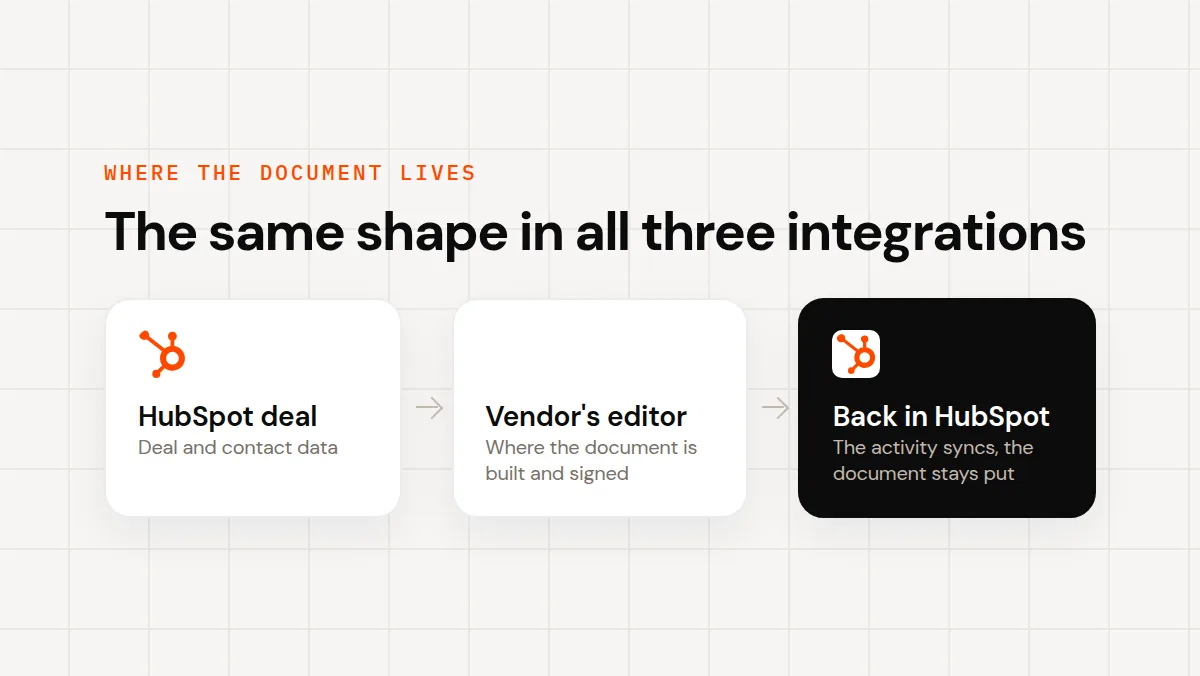
The integrations are more alike than the marketing suggests. In all three, the document is created in the vendor's platform (pre-filled from deal and contact data), activity syncs back to the HubSpot timeline, and the document itself lives in the vendor's system rather than becoming a HubSpot record. The real difference is the paywall: Qwilr includes its integration at $35, Proposify at $41, PandaDoc at $49 per user per month.
Head to head: pricing for a five-person team
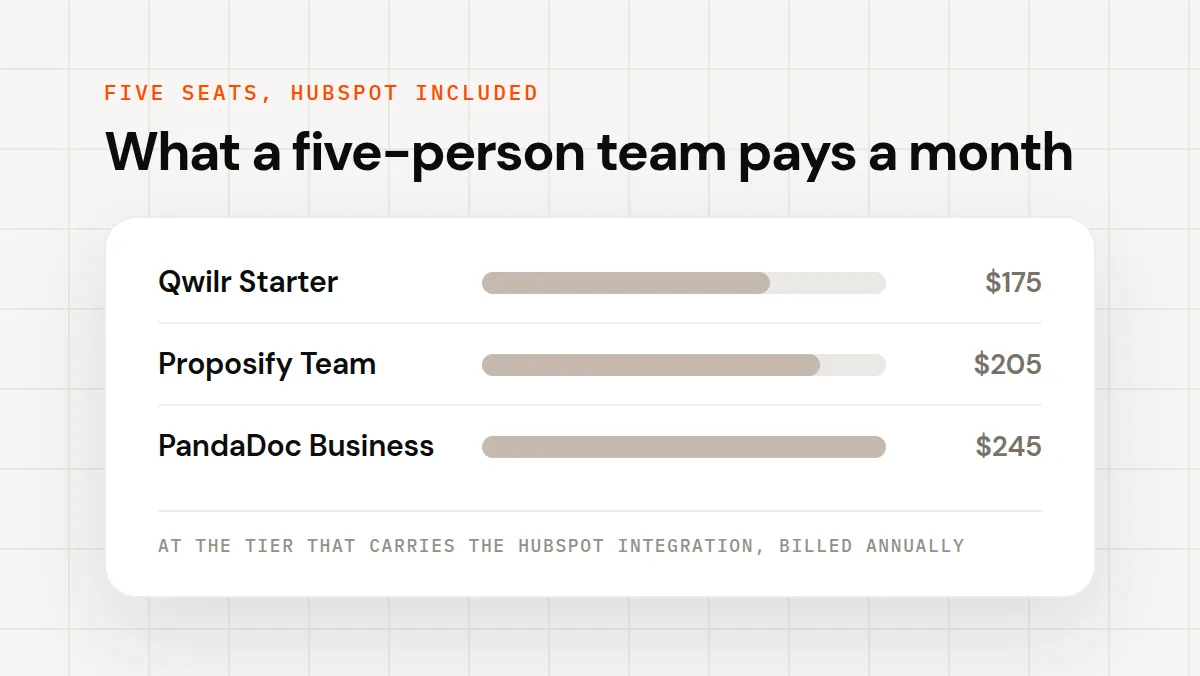
At the HubSpot-integrated tiers, billed annually: Qwilr Starter is $175 a month, Proposify Team is $205, and PandaDoc Business is $245. Over a year that is a $840 spread between the cheapest and most expensive, before add-ons. PandaDoc is the only one where part of the stack (eSign) can stay free while you evaluate the rest.
Which should you pick?
Pick PandaDoc if proposals are only part of the problem and you want contracts, forms, payments, and eSign consolidated in one tool with room to grow.
Pick Qwilr if the proposal is your main sales asset and you sell to buyers who will notice the difference between a PDF and an interactive page.
Pick Proposify if your team is growing and your problem is consistency: locked templates, approval gates, and a managed content library.
Where Portant fits (and the bias disclosed)
I work at Portant, so here is the honest version. All three tools above share the assumption that you should rebuild your documents inside their editor. Portant is built on the opposite belief: your team already has quote, proposal, and contract templates in Google Docs and Word, so the faster path is automating HubSpot deal data into those files, with approval routing and eSignature included, and every finished document saved back onto the deal as a HubSpot record. The Team plan is $125 a month flat for up to five users, versus $175 to $245 for the three tools above.
If that framing fits your stack, the deeper comparisons are here: PandaDoc alternatives, Qwilr alternatives, and Proposify alternatives. If it does not, one of the three tools above will serve you well.
Frequently asked questions
Is PandaDoc or Proposify better?
PandaDoc is the broader platform: it covers proposals, quotes, contracts, and forms, has a free eSign plan, and adds CPQ and payment collection on higher tiers. Proposify is narrower but stronger on control: its content library, approval rules, and template locking keep a growing sales team on-message. For a five-person team, Proposify Team costs $205 a month versus $245 for PandaDoc Business, the tiers each requires for HubSpot integration.
Is Qwilr or Proposify better for proposals?
They disagree about what a proposal is. Qwilr builds interactive web pages with embedded video, pricing tables, and page analytics, which reads as more modern to buyers and starts at $35 per user per month with HubSpot integration included. Proposify builds traditional document-shaped proposals with tighter brand governance and approval workflows, at $41 per user per month on the Team plan. Pick Qwilr for buyer experience, Proposify for control.
What is the difference between PandaDoc and Qwilr?
PandaDoc is a general document platform with a drag-and-drop editor, covering quotes, proposals, contracts, and payment collection, with a free eSign plan. Qwilr does one thing: proposals and quotes as interactive web pages rather than PDF-style documents. If everything you send is a proposal and you want it to feel like a product demo, Qwilr fits. If you need contracts and other document types in the same tool, PandaDoc fits.
Which is cheapest for a five-person team?
At the tiers that include HubSpot integration: Qwilr Starter costs $175 a month (5 x $35), Proposify Team costs $205 (5 x $41), and PandaDoc Business costs $245 (5 x $49), all billed annually. For comparison, Portant's Team plan is $125 a month flat for up to five users, and generates documents from your existing Google Docs and Word templates instead of a new editor.
Do PandaDoc, Qwilr, and Proposify all integrate with HubSpot?
Yes, at different tiers. Qwilr includes HubSpot, Zoho, and Pipedrive integrations on its $35 Starter plan. Proposify's HubSpot integration comes with the Team plan at $41 per user per month. PandaDoc's native HubSpot integration requires the Business plan at $49 per user per month. In all three, documents live in the vendor's platform and sync activity back to HubSpot rather than becoming HubSpot records.